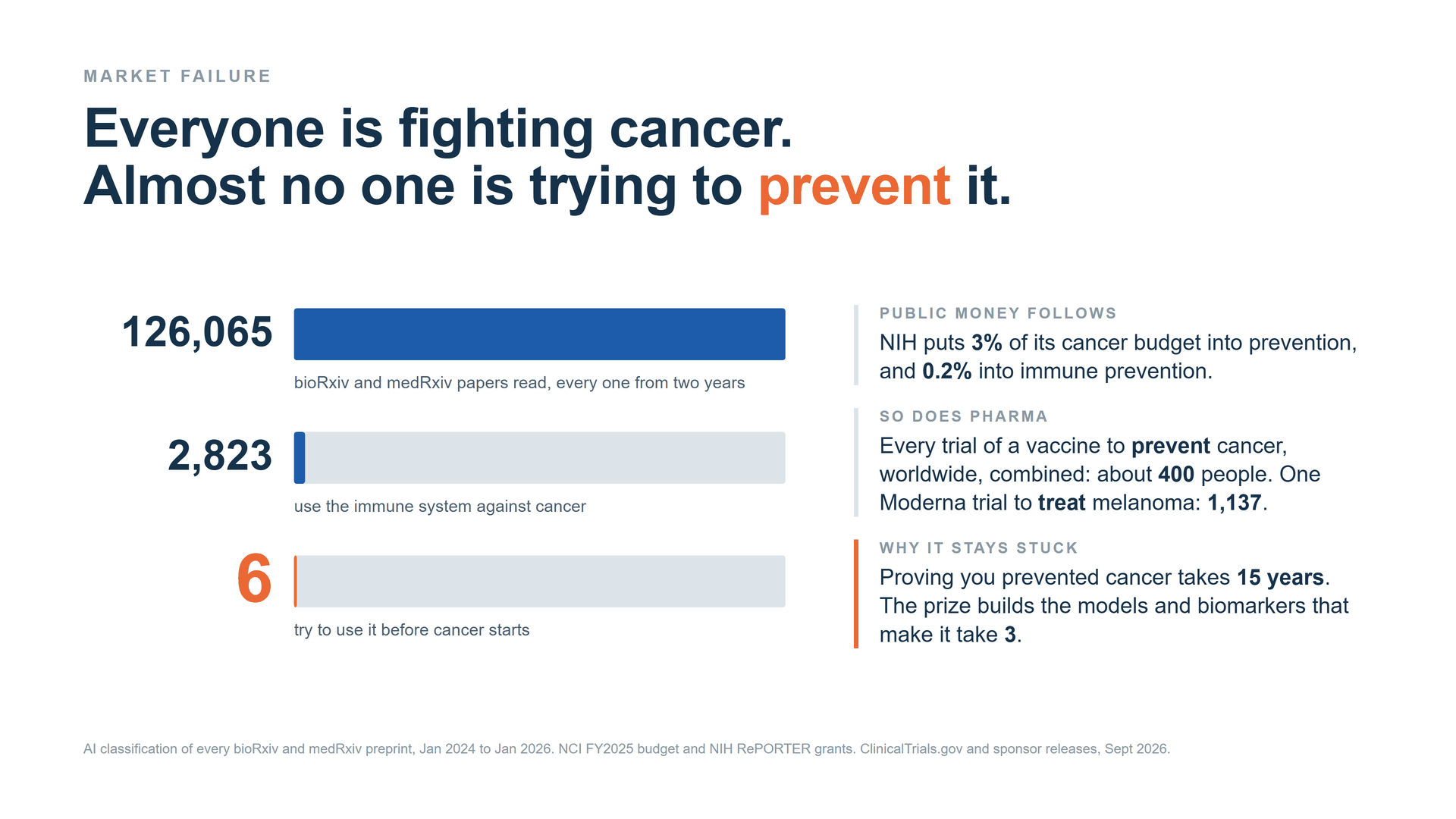
Everyone is fighting cancer. Almost no one is trying to prevent it.
This page is the evidence behind the XCancer pitch: every number on it is measured from data we can show you or taken from a source we link to, and each one carries a marker saying which.
Five slides, thirty seconds each.
The deck as presented. The numbers on the slides are the ones this page documents; the sections below give each one its source. Download the deck as a PDF (2.2 MB).
Where the cancer research effort goes.
One model read every bioRxiv and medRxiv preprint from two years and sorted each by subject, stage and aim. Each row zooms into the highlighted part of the row above. The last row is the whole preventive cancer vaccine literature, hand-checked. Hover a bar for its share.
The same numbers as a table
| Stage | Papers | Share of row above | Share of all |
|---|
Papers measured; shares inferred from the counts. Definitions as in the figure caption.
By source and by year
| Group | bioRxiv | medRxiv | 2024 | 2025 | 2026 | Total |
|---|
All counts measured, run "full". The year is the one encoded in the DOI, since the archive's posted-date column is unreliable. 2026 covers only the first weeks of January, up to the archive snapshot.
The whole preventive cancer vaccine literature, two years, two servers.
Six preprints build or test a vaccine against a tumor antigen with the aim of stopping cancer before it starts. Below them, the 113 papers in the row they came from, searchable. Papers are identified by title, DOI, source and date only.
The hand-checked six
| Paper | Source | Posted | What it is | Stage |
|---|
Membership measured and hand-checked: the classifier flagged 10 vaccine candidates in the 113-paper set (rule: intervention class is a shared-antigen or personalized neoantigen vaccine); a hand read of the 10 confirmed these 6. "What it is" is the hand reader's one-line description. The stage label is the classifier's.
All 113 papers in the strict set
The strict set is every preprint where cancer is the central subject, immunology is the central subject, the stated aim is prevention (or both prevention and treatment), the intervention is not an infection-targeted vaccine, and the work studies a premalignant lesion, a high-risk carrier group or a healthy population measured. The rationale column is the classifier's own one-line reason, at most 25 words, and is not a quote from the paper.
| Posted | Source | Paper | Stage | Intervention | Classifier rationale |
|---|
All labels measured: Claude Haiku 4.5, run "full". Rows shaded orange are the six hand-checked vaccine papers. Download the table as CSV in Downloads.
The people who know how cancer starts and the people who can aim the immune system are different people.
A preventive cancer vaccine needs two bodies of work, and the preprint record shows they are written by different authors, in different departments, and almost never together.
Cancer papers that study mutant clones in normal tissue, precursor lesions, inherited risk or the years before a tumor exists, without immunology as the main subject, from 922 distinct corresponding authors measured. They publish under Cancer Biology, genetic and genomic medicine, epidemiology and gastroenterology.
Papers on making the immune system attack an established tumor, from 2,258 distinct corresponding authors measured. They publish under Cancer Biology, Immunology, Bioinformatics and Bioengineering.
Corresponding authors who appear in both lists measured: 4.1 percent of the pre-cancer authors and 1.7 percent of the immunology authors inferred. Of the fifteen institutions that lead each list, none appears on both measured.
The numbers
| Group | Papers | Distinct corresponding authors |
|---|---|---|
| Pre-cancer biology, immunology not central | 1,004 | 922 |
| Cancer immunology, established tumors | 2,561 | 2,258 |
| Authors in both | 38 | |
| Immunology central and pre-cancer stage | 144 | |
| ... aimed at prevention (the strict set above) | 113 | |
| ... building a vaccine, hand-checked | 6 |
All counts measured from the full classification, run "full", both sources complete. Author matching uses the corresponding author's email where present, otherwise first initial and surname, so it undercounts overlap slightly rather than overcounting it. No author identity is shown on this page.
Why the gap is structural, not accidental
The people who understand precursor lesions work in pathology, gastroenterology, genetics and population science. Their models are cohorts, organoids and lineage tracing, and their endpoint is progression. The people who know how to raise a T cell response work in immunology and bioengineering. Their models are syngeneic tumors in mice and their endpoint is tumor shrinkage. Neither group has a reason to learn the other's tools, because no funder, journal or company asks them to. Grant panels are organised by the same divisions, so a proposal that needs both kinds of reviewer lands between two study sections. Pharma teams are organised by therapeutic area and by trial phase, and a prevention trial in healthy carriers belongs to no existing team.
The clinical side repeats the pattern. The immuno-oncology trialists run adjuvant vaccine studies in people who have already had a tumor removed. The prevention trialists, largely funded through NCI's prevention division, run screening and chemoprevention studies in high-risk cohorts. The five preventive vaccine trials found on clinicaltrials.gov (see what pharma is doing) are the exception, and every one of them is an academic group or small biotech leaning on NCI, with no top-twenty pharma partner reported.
Where the two subjects meet, the literature is thin: 144 papers have immunology central and study a pre-cancer stage, 113 of those aim at prevention, most of those test no intervention (85 of 113), and 6 build a vaccine measured.
Every major funder is at 5 to 15 percent prevention-side. Immune prevention gets a fifth of one percent.
Two independent measurements: who is named in the acknowledgements of cancer preprints, and what NCI actually awarded in fiscal 2025.
Funders named in cancer preprints, bioRxiv
For each cancer-central bioRxiv paper with funding text, we recorded which funders are named and whether the paper is prevention-side (its aim is prevention, or it studies a premalignant lesion, a high-risk carrier group or a healthy population) or treatment-side. A paper can name several funders. Funding text is absent from the medRxiv API, so medRxiv is not included.
| Bucket | Cancer-central papers | With funding text | With at least one recognised funder |
|---|
Coverage measured, run "full", source bioRxiv. Funding text comes from acknowledgement sections, so absence of a funder name is not proof of no funding.
| Funder | Treatment-side papers | Prevention-side papers | Prevention share | Share, to scale |
|---|
Paper counts measured, prevention share inferred (prevention-side divided by the funder's total). Funders are listed in order of total mentions. Small totals give unstable shares: the last rows have single-digit prevention counts.
NCI grants, fiscal 2025
We queried the NIH RePORTER grants database for every NCI award in fiscal 2025 whose title, abstract or terms match immunoprevention or preventive cancer vaccine language (49 grants), then tagged each one by hand from its title to keep only immune approaches to preventing non-viral cancer.
| Category | Grants | Dollars | Share of all NCI awards |
|---|
Grants and dollars measured: NIH RePORTER API, NCI, fiscal 2025, award amounts summed, hand tagging of titles. Shares inferred. Keyword search: api.reporter.nih.gov. The grant list with tags is in nih_immunoprevention_projects_FY2025_retagged.csv.
NCI spent 13.3 million dollars in fiscal 2025 on immune approaches to preventing non-viral cancer, out of 7.59 billion dollars in awards measured. Including the three immunoprevention infrastructure grants it is 16.4 million, 0.216 percent inferred. Viral cancer vaccine work (HPV, EBV and similar) gets about the same again, 12.2 million measured.
NCI's Division of Cancer Prevention received 230.1 million dollars of a 7.221 billion dollar NCI budget in fiscal 2025, which is 3.2 percent reported, from NCI's Budget Fact Book obligations table. The broad prevention keyword set in RePORTER was 949 million dollars, 12.5 percent of awards measured, so immune prevention is about 1.4 percent of what a keyword search calls prevention inferred.
Caveat: the keyword net catches grants whose title, abstract or terms use the words. A grant doing immunoprevention under other language would be missed, so 13.3 million is a floor, not a ceiling. No plausible miss rate turns 0.2 percent into 3 percent.
Every trial of a vaccine to prevent cancer, worldwide, combined: about 400 people.
Five trials of vaccines to prevent non-viral cancer have run since 2018. The highest phase reached is 2b. Every sponsor is an academic centre or a small biotech, and every one leans on NCI money. No top-twenty pharmaceutical company sponsors or partners any of them.
The five preventive trials
| Agent | Population | Phase | Sponsor and funder | Enrolment | Registry |
|---|---|---|---|---|---|
| Nous-209, an off-the-shelf vaccine encoding over 200 shared frameshift neoantigens (gorilla adenovirus prime, modified vaccinia Ankara boost) | Lynch syndrome carriers without active cancer | 1b/2 | NCI (lead sponsor on record); vaccine developed by Nouscom, a private biotech; run through NCI's Cancer Prevention Clinical Trials Network | 45 (actual) | NCT05078866 |
| Tri-Ad5 (three adenovirus vaccines against CEA, MUC1 and brachyury) plus the IL-15 superagonist N-803 | Lynch syndrome carriers without active cancer | 2b, randomised, placebo-controlled | NCI Cancer Prevention Clinical Trials Network; platform developed by ImmunityBio, a mid-cap company | 186 (estimated) | NCT05419011 |
| MUC1 peptide plus poly-ICLC adjuvant | Adults 40 to 70 with a newly diagnosed advanced colorectal adenoma | 2, randomised, placebo-controlled | University of Pittsburgh, NCI-funded Cancer Prevention Network | 110 (actual) | NCT02134925 |
| MUC1 peptide plus poly-ICLC adjuvant | Current and former smokers with 30 or more pack-years, at high risk of lung cancer | 1, pilot | NCI-funded Cancer Prevention Network, University of Pittsburgh | 50 (actual) | NCT03300817 |
| Alpha-lactalbumin vaccine with zymosan adjuvant | Mixed: 26 triple-negative breast cancer survivors after treatment, 5 on adjuvant pembrolizumab, and 4 cancer-free BRCA1, BRCA2 or PALB2 carriers before a preventive mastectomy. Only the 4 are primary prevention. | Early phase 1 | Cleveland Clinic, US Department of Defense grant, Anixa Biosciences (small biotech) | 35 (actual) | NCT04674306 |
| Combined enrolment | 426 | ||||
All entries reported from clinicaltrials.gov records and sponsor releases, checked September 2026. The combined figure of 426 is inferred by adding the five enrolments; counting only the preventive arm of the alpha-lactalbumin trial it is about 395, which is why the pitch says "about 400". Two candidates were checked and excluded: PolyPEPI1018 (Treos Bio, NCT05243862) because it is given to people who already have metastatic colorectal cancer, and CHIP-directed immune interventions because none with a cancer endpoint was found. Result publications: Nous-209 in Nature Medicine; MUC1 adenoma trial in Clinical Cancer Research; MUC1 smokers trial in PMC; alpha-lactalbumin cohorts in a Cleveland Clinic release.
The contrast: what the same industry runs after the tumor
The large pharmaceutical companies are running cancer vaccine trials at scale, all adjuvant, all in people who have already had a tumor removed reported.
| Program | Setting | Phase | Enrolment | Status | Source |
|---|---|---|---|---|---|
| Merck and Moderna, intismeran autogene (V940, mRNA-4157) plus pembrolizumab, INTerpath-001 | Completely resected stage IIB to IV melanoma | 3 | 1,137 | Met its recurrence-free survival and distant metastasis-free survival endpoints at interim analysis (NCT05933577) | Merck release |
| Merck and Moderna, V940 plus pembrolizumab, INTerpath-002 | Completely resected stage II to IIIB non-small cell lung cancer | 3 | about 868 planned | Enrolling | Merck release |
| Merck and Moderna, V940 plus pembrolizumab, INTerpath-009 | Resectable non-small cell lung cancer without pathological complete response after neoadjuvant therapy | 2/3 | not stated | Initiated 2024 | Applied Clinical Trials |
| BioNTech and Genentech (Roche), autogene cevumeran, BNT122-01 | ctDNA-positive resected stage II to III colorectal cancer | 2 | not stated | Terminated August 2026 on a data safety monitoring board futility recommendation (NCT04486378) | BioNTech statement |
| BioNTech and Genentech (Roche), autogene cevumeran plus atezolizumab, IMcode003 | Resected pancreatic ductal adenocarcinoma | 2 | about 260 planned | Continuing (NCT05968326) | BioNTech release |
All entries reported from sponsor releases and registry records, checked September 2026. Deal values and program spend are not verified and are not quoted anywhere on this page; enrolment and phase are.
Pharma builds prevention when the trial is short
A 39 percent decline versus 2024, which Merck attributes to lower demand in China and the end of a catch-up program in Japan measured, from Merck's full-year 2025 results.
Up 8 percent versus 2024 measured, from GSK's full-year 2025 results.
Both are vaccines that prevent a cancer or a disease with a short trial and a correlate of protection. Pharma funds prevention when those two things exist. Building them for non-viral cancer, which is most cancer, is what the prize does. The 400-person figure and the 0.175 percent both exclude HPV and other viral cancers on purpose.
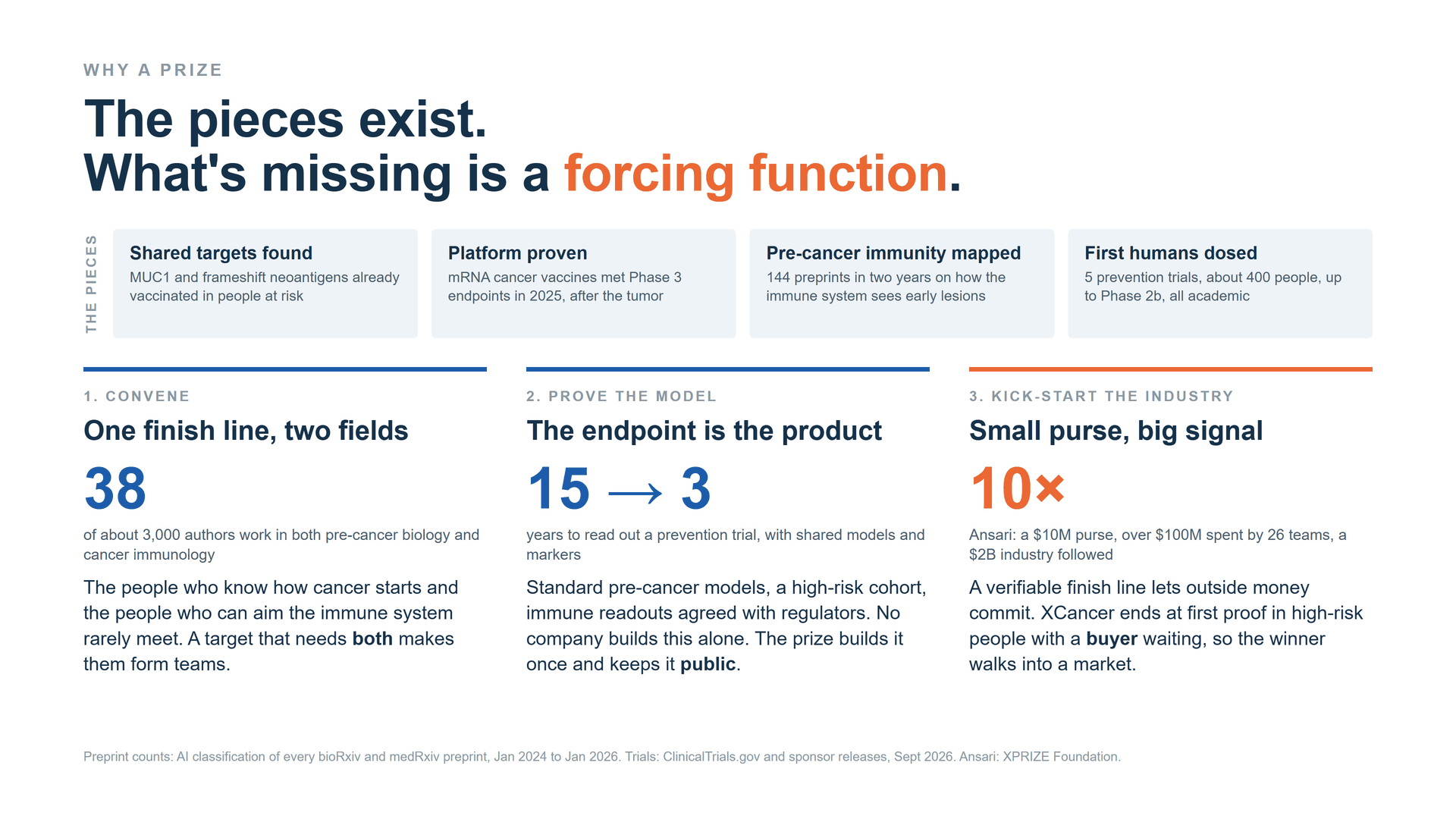
The pieces exist. What is missing is a forcing function.
The science is not the problem. What does not exist is a reason for the people who hold the pieces to work together, a shared yardstick, and a signal that lets outside money commit.
The pieces
Three things a prize does that a grant cannot
38 of about 3,000 corresponding authors work in both pre-cancer biology and cancer immunology measured; "about 3,000" is the rounded union of 922 and 2,258 inferred. A target that needs both makes them form teams: the winning entry must show reduced cancer incidence in models of precursor disease and a durable antigen-specific immune response, so a team must contain both fields.
From 15 years to 3 to read out a prevention trial expected: 15 is a stated assumption about incidence-endpoint prevention trials (the tamoxifen and aspirin prevention trials each needed a decade or more of follow-up, see the method section), and 3 is the prize's design target. Standard pre-cancer models, a high-risk cohort and immune readouts agreed with regulators, built once by the prize and kept public.
The Ansari XPRIZE purse was 10 million dollars; 26 teams from 7 nations spent more than 100 million dollars, and a 2 billion dollar private space industry followed reported, from the XPRIZE Foundation and its account of the win; an outside telling is the Philanthropy Roundtable case study.
What the Ansari parallel actually teaches
Three design features did the work, and the purse was the least of them. The target was concrete, verifiable and reachable inside the window (100 kilometres twice in two weeks) and required no one's permission. The announced finish line let outside money commit before anyone had flown. And the win landed alongside a regulatory change, the 2004 Commercial Space Launch Amendments Act, that gave the industry a legal path to exist. The prize supplied the demonstration and the legitimacy; the law supplied the market reported, sources as above.
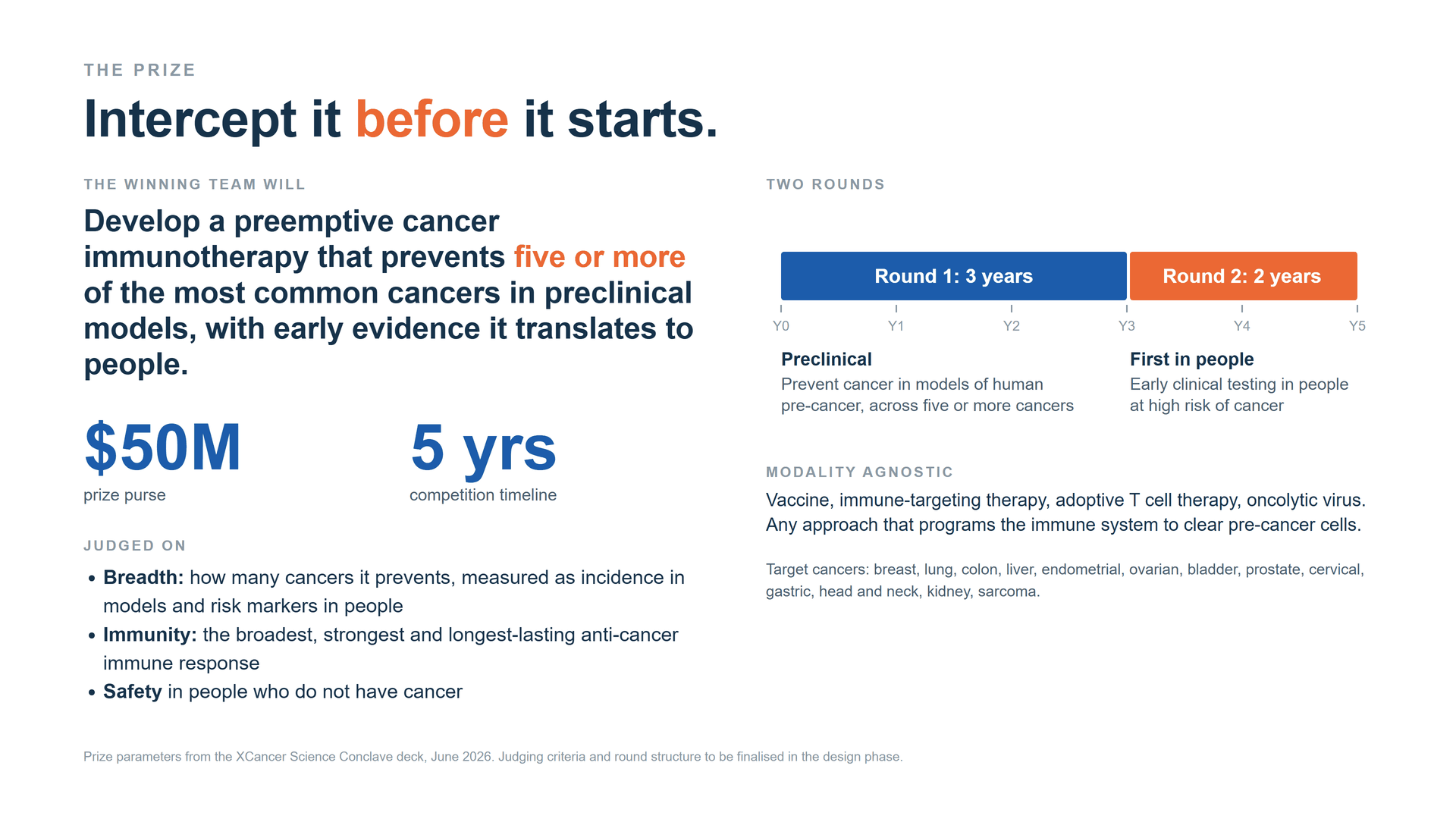
The XCancer equivalents: a finish line judged on both incidence reduction in precursor models and a durable antigen-specific immune response, so a team must contain both fields; shared testbeds run by the prize; endpoints agreed with regulators in advance as the prize's lasting product; and a named downstream buyer, an advance market commitment or a public purchaser for the first high-risk population, so the winner walks into a market rather than off a cliff expected.
The design phase: what 500,000 dollars builds in twelve months
Every deliverable is a thing that does not exist today and that no single lab or company would build for itself. The design phase is the first piece of the yardstick, not planning money. Scope proposed for discussion; deliverables and budget split to be confirmed with the XCancer prize team expected.
| Deliverable | What it is | Exists today | |
|---|---|---|---|
| 1 | The finish line, written with regulators at the table | What counts as prevention in a model and in a person, agreed before anyone competes | No |
| 2 | A standard panel of pre-cancer models and immune readouts | So every team is measured on the same track and results compare | No |
| 3 | High-risk cohorts and biobanks identified for Round 2 | Lynch and BRCA carriers, clonal hematopoiesis, precursor lesion registries | Scattered |
| 4 | A buyer for the winner | Conversations opened with payers and public purchasers so the prize ends at a market, not a cliff | No |
| 5 | The launch-ready rulebook and judging panel | Eligibility, rounds, scoring, safety oversight, and the scientific chairs | Draft |
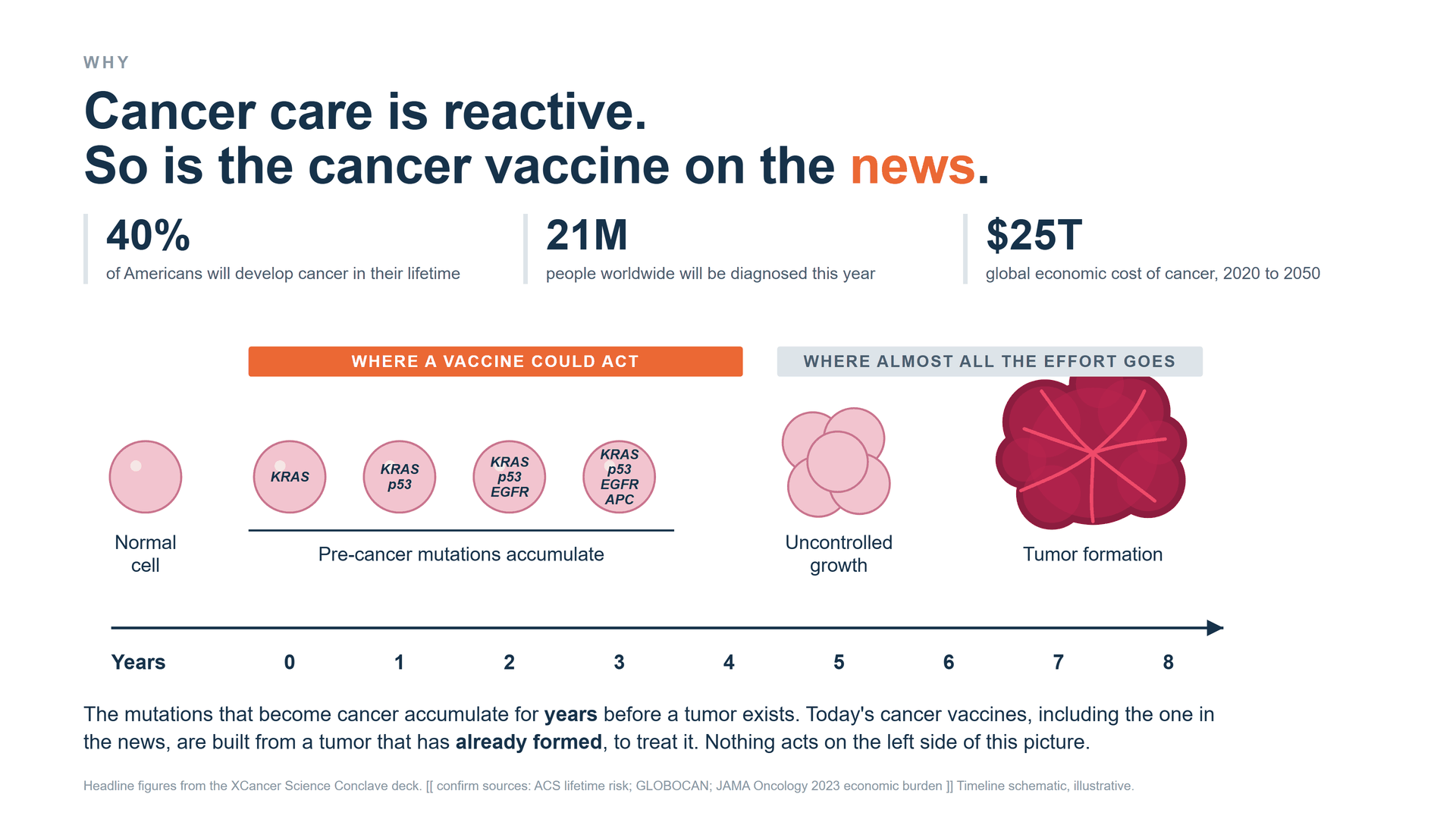
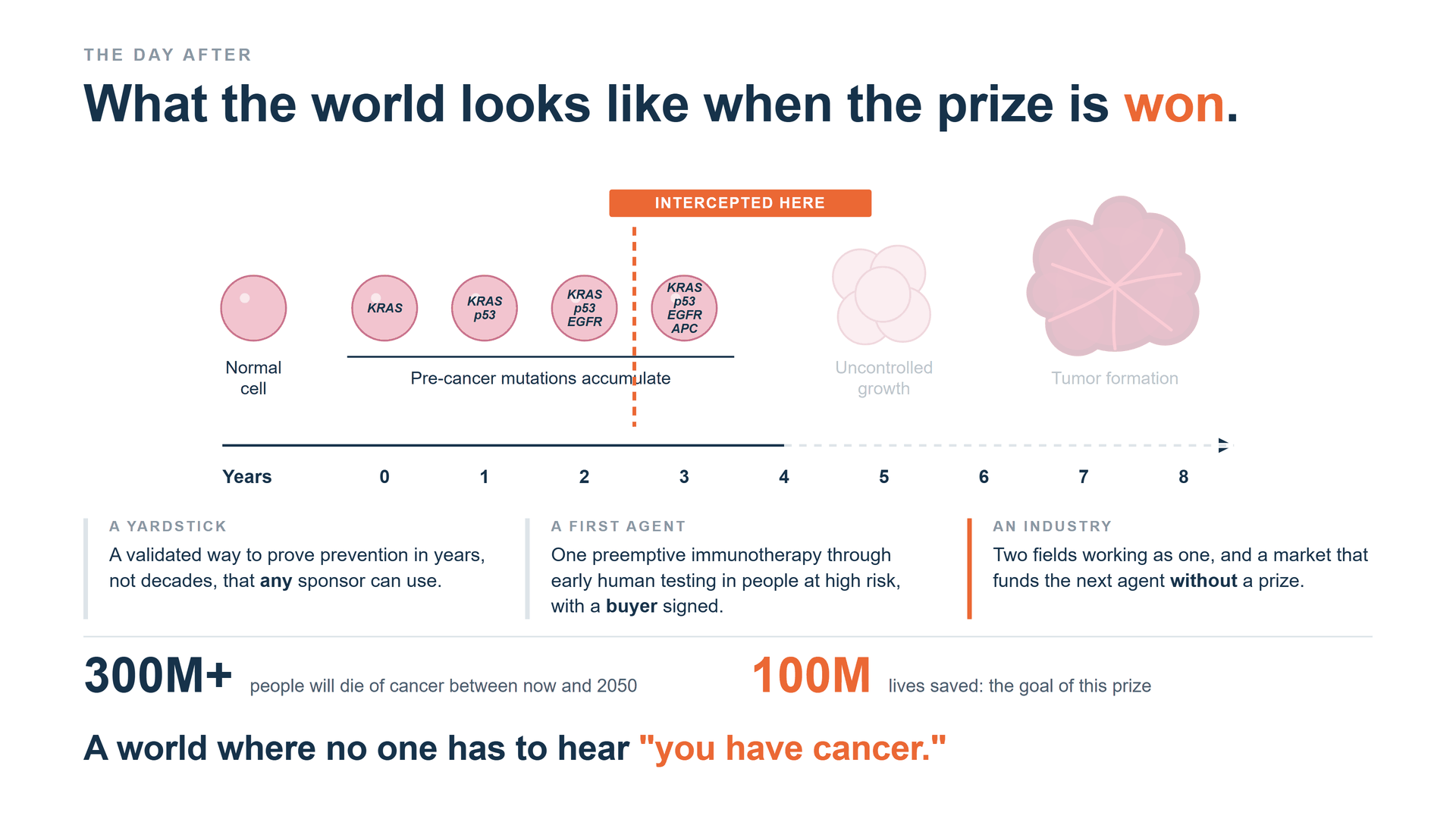
Cancer will kill more than 300 million people between now and 2050.
The goal behind the prize is to save 100 million of them. That is about a quarter of the projected deaths, and it sits inside the share that public health already attributes to preventable causes.
A deliberately conservative floor that holds deaths flat at the 2022 level for 25 years gives 242 million inferred. Either way, more than 300 million is supported. Saving 100 million lives over the period is 26 percent of the interpolated total, or 41 percent of the flat floor inferred. Both sit below the reported share of cancer deaths attributed to modifiable risk factors: 44 percent globally in the GBD 2019 analysis and 50 percent of US deaths by the American Cancer Society reported. The WHO states that 30 to 50 percent of cancers are preventable reported.
Infections cause a reported 13 percent of cancer cases, the share that HPV and hepatitis B vaccines already address reported, de Martel and colleagues, Lancet Global Health 2020. The remaining roughly 87 percent is where no preventive vaccine exists inferred. That is the scope of the prize.
Sources with URLs, and the interpolation, are in lives_at_stake.md. No published source states a cumulative 2020 to 2050 death total; the 300 million figure is this page's interpolation and is described as such.
How the counting was done, and what it cannot tell you.
Every abstract was read by one model with one prompt. The prompt, the checks on it and the known error rate are below, so the numbers can be argued with rather than taken on trust.
Window and sources
Every bioRxiv paper first posted from 1 January 2024 to the January 2026 archive snapshot, read from a local copy of the bioRxiv JATS archive: 97,078 DOIs in the window, of which 97,072 have an abstract of at least 200 characters measured. Every medRxiv paper in the same window from the public API: 28,998 records, of which 28,993 have an abstract of at least 200 characters measured. Total classified: 126,065. Papers are dated by the date encoded in the DOI, since the archive index's posted-date column is unreliable; bioRxiv changed its DOI prefix in December 2025 and both prefixes are handled.
Classification
Claude Haiku 4.5 (claude-haiku-4-5-20251001) read the title and abstract of every paper, in batches of six, and returned a fixed set of labels per paper. Only the abstract is read; full text is not copied into the study. The fields:
- cancer_relevance
- none, peripheral or central: whether cancer (any neoplasm, including premalignant lesions and clonal precursors) is the main subject.
- immunology_relevance
- none, peripheral or central, judged independently of cancer: whether the immune system or an immune-based intervention is the main subject.
- disease_stage
- established tumor; recurrence or residual disease; high-risk carrier (germline predisposition or another defined high-risk state before any cancer); premalignant lesion (adenoma, Barrett's, CIN, DCIS, IPMN, MGUS, clonal hematopoiesis, mutant clones in normal tissue); healthy population; or not applicable.
- intervention_class
- personalized neoantigen vaccine; shared antigen vaccine; infection-targeted vaccine (HPV, HBV, EBV, H. pylori); checkpoint or other immunotherapy; cell therapy; other intervention; or none.
- orientation
- treatment (including preventing recurrence after treatment), prevention (stopping cancer from arising or intercepting premalignant disease), both, or not applicable.
- two flags
- premalignant_mutation_biology (how somatic mutations or clones accumulate before invasive cancer) and immune_surveillance_premalignant (immune recognition or escape of premalignant cells).
- confidence and rationale
- A number from 0 to 1 and a reason of at most 25 words. Of the 126,065 papers, 90,303 were labelled at confidence 1.0, 25,846 at 0.9, 9,086 at 0.8 and 830 below that measured.
The prompt carries eight rules, added after the first pilot review:
- Judge only from the text given; use "none" and "not applicable" freely for papers unrelated to cancer.
- If cancer relevance is none, the stage and orientation must be not applicable (also enforced after the fact in code).
- A disease stage is assigned only when the methods or results actually study a cohort, model, tissue or samples at that stage; cancer as background or motivation earns no stage.
- Clonal hematopoiesis and other mutant clones in normal tissue are a premalignant lesion, not a high-risk carrier; high-risk carrier is for germline predisposition or another defined high-risk state in people.
- A vaccine subclass requires that a vaccine is actually designed, tested or explicitly proposed; a database, antigen discovery, immunopeptidome, binder design or platform paper is "none".
- Infection-targeted vaccine is only for HPV, HBV, EBV or H. pylori; vaccines against other pathogens are "other intervention" if the paper is about cancer.
- Checkpoint immunotherapy and cell therapy require that the intervention is administered or tested, not only discussed as rationale.
- Output valid JSON only.
The precision check
A 50-paper review sheet, stratified toward rare and borderline labels, was judged field by field (7 fields, 350 label decisions) by an independent checker. With the first prompt, the model agreed with the checker on 301 of 350 decisions (86.0 percent); with the eight rules above, 307 of 350 (87.7 percent) measured. Disease stage improved from 37 to 44 of 50; the other fields moved within noise, 29 fixed and 23 newly wrong, which shows run-to-run variability of about one label in ten on borderline papers. The headline funnel on a random sample of 500 was identical in both runs. A test of a larger model (Claude Sonnet) on the same 50 papers agreed on 310 of 350 (88.6 percent), within the run-to-run noise, so it was not adopted. Because the review sample is stratified toward hard cases, agreement on the random population is higher than these figures.
The hand check of vaccine candidates
The classifier flagged 10 vaccine candidates in the 113-paper strict set. A hand read of the 10 confirmed 6 as genuine preventive tumor-antigen vaccine papers (three MUC1 vaccine studies, a Lynch syndrome frameshift peptide vaccine, and two vaccines tested against early lesions in mice), removed 3 as misclassified (an HIV vaccine study, an HPV web database, and a BCG trained-immunity epidemiology paper), and set 1 aside as borderline (an HPV E6/E7 mRNA vaccine in cervical precursor lesions, excluded by the row's HPV rule). If someone says "seven", that one is the honest answer measured hand-checked.
Caveats
- These are preprints, not the whole literature. Preprints are where the research pipeline shows itself before journals and funders filter it. If anything, the published literature is more treatment-heavy.
- Labels come from abstracts, not full text. A paper whose abstract understates its prevention aim is undercounted.
- Any one label can be wrong at about the one-in-ten rate above. The funnel rows are counts over thousands of papers, where errors in both directions partly cancel; the six-paper row is hand-checked because at that size they do not.
- Preprint funder counts cover bioRxiv only (71 percent of its papers have funding text) and depend on funder names being written in the acknowledgements. medRxiv's API carries no funding field.
- The NCI grant figure is a keyword search plus hand tagging, so it is a floor. The trial and pharma facts are as stated in registry records and sponsor releases on the dates checked, and can change.
- The 15-year figure for prevention trials is an assumption, not a measurement. The NSABP P-1 tamoxifen trial reported a median follow-up of 54.6 months at first report with risk reduction persisting at least 10 years, and the CAPP2 aspirin trial in Lynch syndrome followed participants for a mean of more than 7 years after the intervention with registry follow-up out to 20 years reported, from a summary of NSABP P-1 and the CAPP2 long-term report.
The marker convention
Every number on this page carries one of four markers.
The full classification data (every DOI with its labels, confidence and rationale) is available on request.
Take the evidence with you.
Everything on this page, as files. Paper tables carry title, DOI, source, date and the classifier's labels only.
- deck.pdfThe five-slide pitch deck, 2.2 MB.
- strict_set_113_papers.csvThe 113 papers in the strict set with stage, intervention, orientation and rationale.
- preventive_vaccine_6_papers.csvThe six hand-checked preventive vaccine papers.
- preprint_funders_biorxiv.csvFunder mentions in cancer-central bioRxiv preprints, treatment-side and prevention-side.
- nih_immunoprevention_projects_FY2025_retagged.csvThe 49 NCI fiscal 2025 grants matched by the keyword search, with hand tags. Grantee names and institutions removed; the project numbers resolve on RePORTER.
- lives_at_stake.mdSourced mortality figures and the interpolation behind the 300 million and 100 million lines.
- data.jsonEvery number on this page in one file: funnel, strict set, counts by year and source, funder table, NCI summary.
- market_failure_slide_notes.mdSpeaker notes for the market failure slide, with every number's marker and source.
- why_xprize_slide_notes.mdSpeaker notes for the why-a-prize slide, with the Ansari sources.